insight
Which department will benefit most from an AI implementation?
7 June 20266 min read
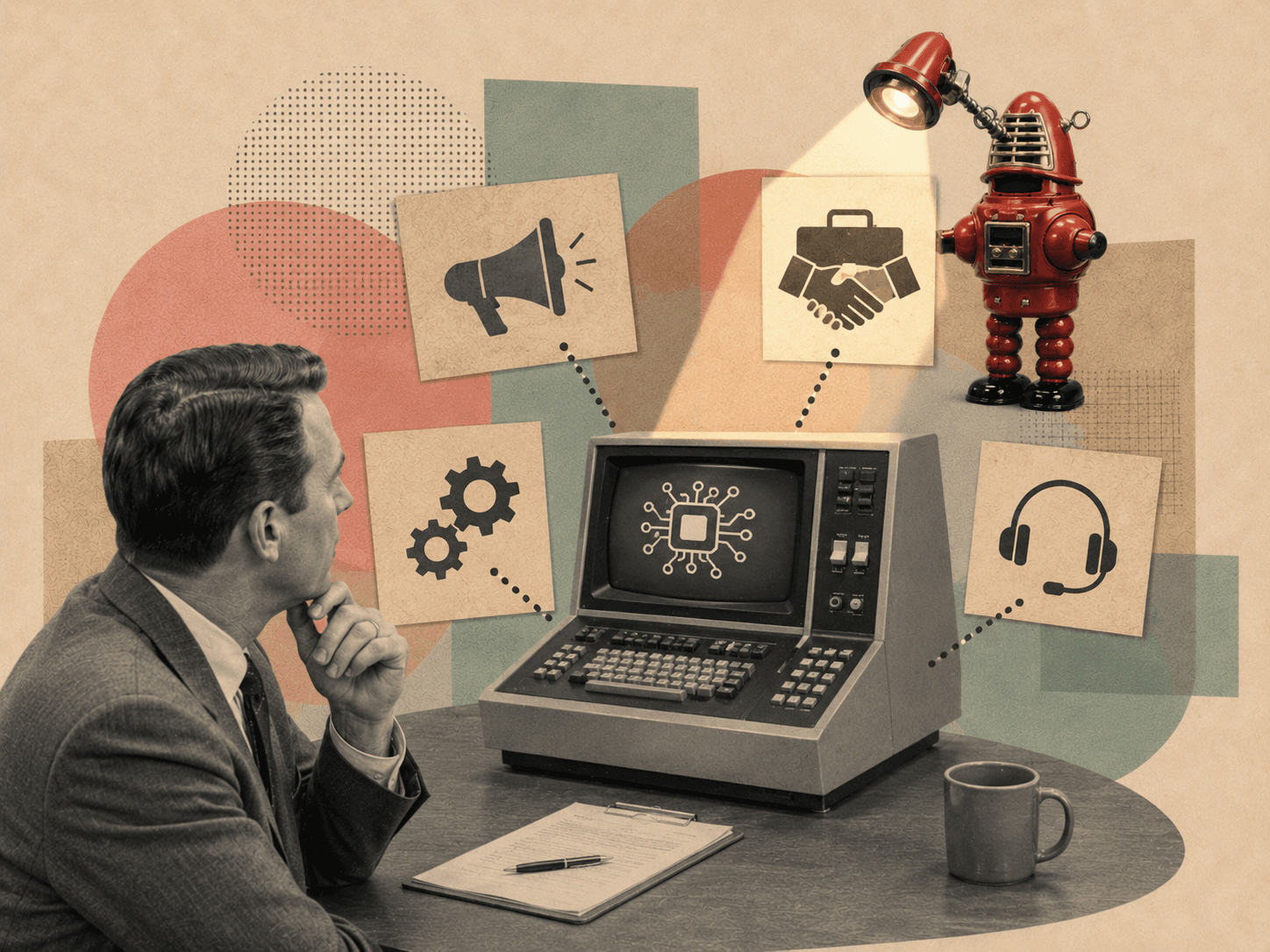
The best first AI implementation is rarely the flashiest one. It is the department with repeatable work, accessible data, clear ownership, and measurable pain.
The department that benefits most from AI is not always the one asking for it.
That is the first thing to understand.
Marketing often asks first because the tools are visible. Sales asks because lead research is painful. Customer service asks because the queue never stops. Finance asks because reporting is repetitive. Operations asks because half the business runs on spreadsheets and tribal knowledge.
They may all be right.
But the best first AI implementation is not chosen by enthusiasm alone. It is chosen by a mix of pain, process, data, risk, and ownership.
The question is not "which department could use AI?"
They all can.
The better question is: where will AI create measurable improvement without creating unacceptable risk?
The test I use
Before choosing a department, I would score four things.
Repetition. Is the work done often enough for improvement to matter?
Judgement. Does the work require human approval, or can parts of it be safely automated?
Data. Is the information needed to do the work available, current, and usable?
Ownership. Is there a manager who wants the change and will own adoption after the demo?
If those four are present, AI has a chance of becoming a system.
If they are missing, it becomes a toy.
Customer service: often the fastest visible win
Customer service is usually one of the strongest candidates.
The work is repetitive. The pain is obvious. The knowledge base exists somewhere, even if it is messy. The output can be reviewed before it reaches a customer. The impact is easy to measure: first response time, resolution time, backlog, escalation rate, customer satisfaction, and agent workload.
Good AI in customer service does not mean replacing the team with a chatbot.
That is usually the wrong starting point.
The better first move is internal assistance:
- draft replies from approved sources;
- summarise ticket history;
- suggest the likely category;
- surface relevant policy or product information;
- flag urgent or risky cases;
- route work to the right person;
- identify repeated questions that need better documentation.
This helps the team move faster without handing the customer experience to an unsupervised model.
For many SMEs, customer service is the best first department because the work is structured enough to help, but human review can stay in the loop.
Sales: strong upside, but watch the nonsense
Sales can benefit enormously from AI, especially in B2B.
Lead research, account enrichment, call preparation, proposal drafting, CRM clean-up, follow-up emails, and pipeline analysis are all good use cases.
The risk is that AI makes bad sales behaviour faster.
If the team already sends generic outreach, AI can generate more generic outreach. If the CRM is a mess, AI can create confident summaries of unreliable data. If qualification is weak, AI can make poor-fit prospects look busy rather than useful.
The best sales implementations are narrow:
- build a target account list from clear criteria;
- enrich companies with source links;
- summarise why an account might be relevant;
- draft a first-touch email for human review;
- identify stalled opportunities;
- compare notes against the qualification framework.
Sales benefits when AI improves focus.
It struggles when AI is used to spray more noise into the market.
Marketing: easy to start, easy to do badly
Marketing is the obvious AI department because content tools are everywhere.
But that is also the danger.
AI can help with research, outlines, repurposing, editing, campaign variants, persona questions, SEO briefs, content audits, and performance analysis. Used well, it removes blank-page friction and helps a small marketing team behave like a larger one.
Used badly, it fills the website with generic sludge.
The best marketing use cases are not "write us 100 blog posts".
They are:
- turn customer questions into content ideas;
- audit existing pages for gaps;
- rewrite service pages for clarity;
- produce first drafts from expert input;
- repurpose webinars or calls into useful articles;
- compare content against search intent;
- create briefs for pages that genuinely need to exist.
Marketing can benefit quickly, but it needs a strong editorial bar.
If the business has no point of view, AI will not invent a good one.
Finance: valuable, but needs controls
Finance teams often have repeatable pain: reporting, variance analysis, invoice queries, margin checks, cashflow commentary, budget explanations, and spreadsheet reconciliation.
AI can help, but finance is not a place for casual automation.
The useful work is decision support:
- explain month-on-month movement;
- flag unusual transactions;
- classify spend;
- summarise debtor risk;
- generate commentary for management packs;
- compare forecast assumptions;
- help non-finance managers understand numbers.
The model should not be treated as the ledger. It should sit beside the finance process, explaining, drafting, checking, and escalating.
Finance benefits most when the data is structured and the outputs are reviewed.
If the underlying data is messy, start there first.
Operations: often the biggest hidden prize
Operations is where AI can become genuinely valuable.
That is also why it is harder.
Operational teams sit on knowledge that is scattered across systems, spreadsheets, emails, SOPs, PDFs, ERP fields, supplier notes, product exceptions, and people's heads. The work is messy, but the cost of that mess is real.
Good operational AI can:
- answer questions from approved documents;
- surface exceptions in orders, pricing, or stock;
- summarise supplier performance;
- support onboarding and training;
- turn messy notes into structured records;
- identify process bottlenecks;
- help teams follow SOPs without searching through folders.
This is where AI stops being a writing tool and starts becoming operating leverage.
But operations needs more groundwork: data access, permissions, process mapping, and clear ownership.
If those exist, operations may deliver the biggest return.
HR and people teams: useful, but sensitive
HR can use AI for policy search, onboarding, training material, job description drafts, interview structure, employee communication, and internal knowledge support.
It can also create risk quickly.
Anything involving performance, hiring, dismissal, grievance, health, protected characteristics, or legal interpretation needs care. AI should not become an invisible decision-maker in people processes.
The safer first HR use cases are internal support:
- find the right policy;
- draft neutral communications;
- prepare onboarding checklists;
- summarise training needs;
- help managers ask better questions before escalating.
HR can benefit, but governance matters more than speed.
IT: the enabler and the bottleneck
IT may not always be the first beneficiary, but it is almost always involved.
Security, identity, data access, integrations, logging, procurement, and vendor control sit somewhere near IT. If IT is bypassed, AI implementations become shadow systems. If IT blocks everything, the business routes around it.
The right role for IT is not "say no".
It is to create safe paths:
- approved tools;
- data rules;
- access patterns;
- integration standards;
- monitoring;
- audit trails;
- escalation routes.
AI needs IT discipline, but not IT theatre.
So which department should go first?
My usual answer is:
Start where the work is repetitive, the data is accessible, the risk is manageable, and the owner is serious.
In many SMEs, that means customer service, sales operations, or a narrow operational workflow.
Marketing is easy to start, but easy to dilute. Finance and HR can be valuable, but need stronger controls. Operations may offer the biggest prize, but usually needs more preparation.
The best first implementation is not the department with the loudest AI champion.
It is the department where you can ship something narrow, useful, measurable, and safe.
Once that works, the organisation starts to believe.
And belief matters. Not hype. Not a big town hall. Practical belief earned by seeing a painful workflow get better.
That is when AI moves from experiment to operating system.
Get Actionable AI in your inbox.
One practical AI play per issue. Sent occasionally, never filler.
Ready to use AI seriously?
A 30-minute call. No deck, no follow-up nurture sequence. I'll tell you whether I can help.