case study · Multi-brand industrial group
Consolidating 8 brands onto a single ERP in 12 months
8 → 1
ERP estates consolidated
December 2024
fractional-cio · ai-consulting
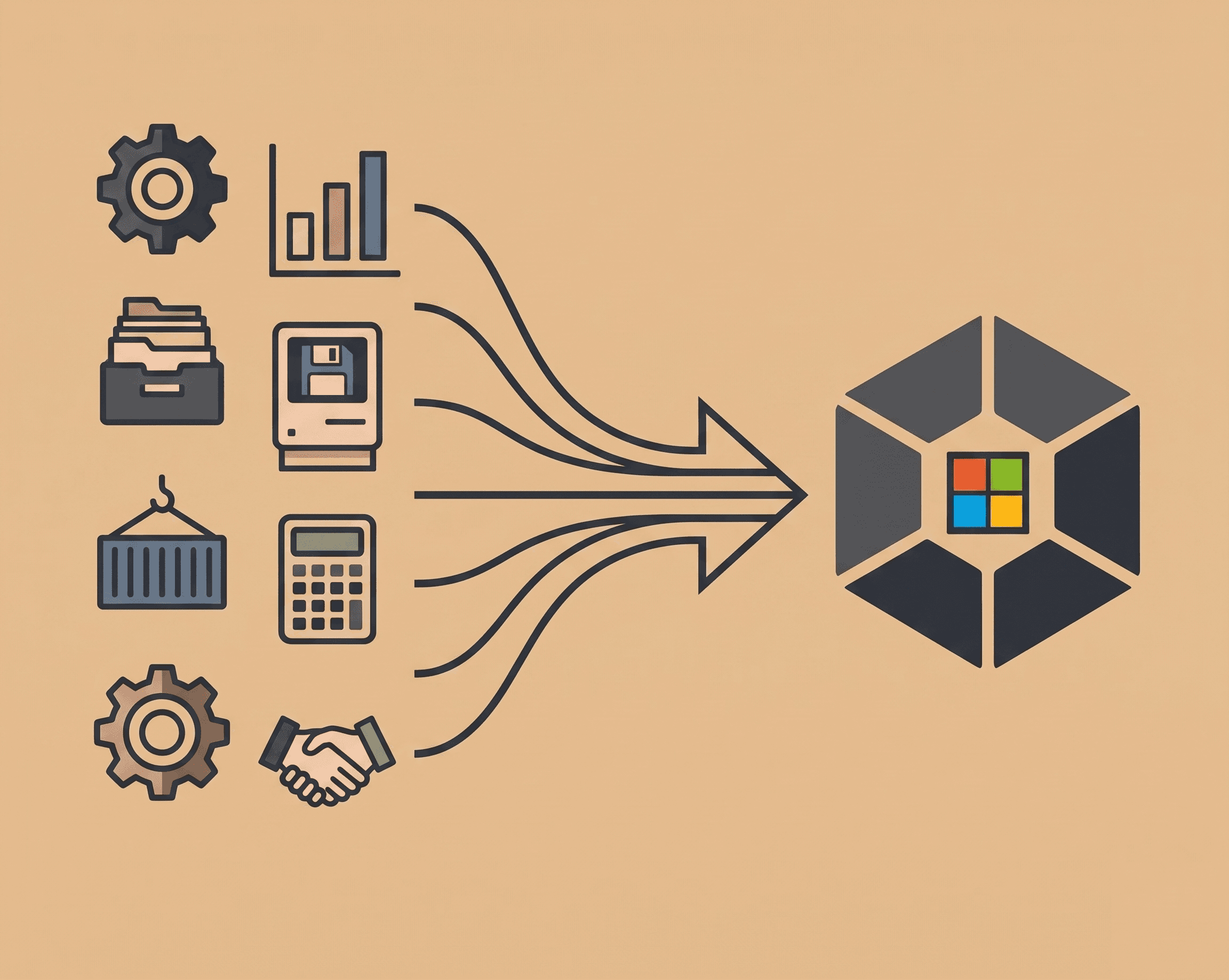
An 8-brand industrial group running on four different ERPs — migrated onto Microsoft Dynamics 365 Business Central in a single 12-month programme, with no operational downtime.
The headline
An 8-brand industrial group with operations across multiple continents was running on four separate ERP systems — a mix of legacy on-prem, inherited from acquisitions, and bolted-together integrations. Over 12 months, I led the consolidation onto a single Microsoft Dynamics 365 Business Central tenant with brand-level companies underneath, retiring the four legacy systems without operational downtime.
Context
- Four ERPs across the portfolio: a mix of on-prem legacy systems inherited from acquisitions, a mid-market cloud ERP picked up along the way, and a spreadsheet-driven setup that had grown well beyond what spreadsheets should be asked to do
- Costs of fragmentation: duplicated finance close work, no group-level reporting, integration sprawl, every acquisition adding more
- Operational risk: vendor lock-in, end-of-life systems, key-person dependency on legacy setups
- Acquisitions on the roadmap that would compound the problem if not addressed
What was at stake
The obvious path was a brand-by-brand rollout over three years. We chose the harder, faster option for a specific reason: rolling consolidation means rolling dual-running costs — two finance teams, two integration surfaces, two charts of accounts in flight at all times. A single 12-month programme front-loads the disruption, but locks in one chart of accounts, one master data model, and one finance close from the moment each brand cuts over. The board got through the pain once, not eight times.
Approach
1. Discovery and design (months 1–3)
- Process mapping across all 8 brands to identify the genuine common spine
- Chart of accounts design — single group chart with brand-level dimensions
- Master data definition: customers, vendors, items, units of measure
- Decision on company-per-brand vs single-company-with-dimensions (we went company-per-brand for statutory clarity)
- Implementation partner selection
2. Foundation build (months 3–6)
- Group chart of accounts and posting setup
- Master data cleansing — the work that's never sexy but always the difference between a clean go-live and a year of patching
- Integration architecture: which systems stay, which retire, what new connectors are needed
- Pilot brand selected — smallest geography, lowest risk
3. Phased cutovers (months 6–12)
- Pilot brand go-live, lessons captured
- Sequential cutovers across the remaining 7 brands, roughly one per month
- Parallel running kept deliberately short to control cost and avoid two systems of record drifting apart
- Finance close performed on the new system from cutover month one for each brand
4. Decommissioning
- Legacy systems kept read-only for statutory retention windows, then archived to cold storage with documented restore paths
- Integration surface area reduced to a single Business Central tenant — every external system that previously connected to one of the four ERPs now connects to one
Outcome
- All 8 brands operating on a single Business Central tenant within 12 months from kickoff
- Four legacy systems retired
- Group-level financial reporting available for the first time — what used to be a manual brand-by-brand consolidation now lives in one place
- A five-figure annual reduction in legacy licence and maintenance costs once the old contracts wound down
- Month-end close performed centrally rather than brand-by-brand, materially faster than the previous process
- Stock and customer data visible at group level, where previously each brand reported on incompatible item codes and customer records
- Platform now ready for further bolt-on acquisitions to be integrated in weeks rather than years
What we learned
- Master data cleansing should start in month one, not month three. Every week of clean data work in discovery pays back tenfold during cutover.
- Brand sequencing matters more than you'd think. "Smallest first" is the default advice, but "least integrated first" is often the better call — it isolates risk to the brand whose dependencies you most understand.
- The integration partner's appetite for the unglamorous work — data, change management, training — matters more than their slide-deck capability statement. Pick on that, not on logos.
Stack
- ERP: Microsoft Dynamics 365 Business Central (SaaS)
- Reporting: Power BI on top of the Business Central financial model
- Integrations: Native Business Central connectors where they existed; Continia for finance automation; a small set of bespoke connectors built for the legacy systems being retired
- Add-ons: Continia for AP automation and document capture; standard Microsoft AppSource ISVs where they fit the need without bespoke development
Related capability
This engagement sits at the heart of a Fractional CIO scope. The data and integration work that surrounded it draws on the same playbook used in the AI consulting practice.
Ready to use AI seriously?
A 30-minute call. No deck, no follow-up nurture sequence. I'll tell you whether I can help.